ServicesAppliance Removal
Appliance Removal in Conyers
We disconnect, carry out and haul away the refrigerators, washers, dryers, ranges and water heaters you no longer want. Each one leaves your home without scuffed floors or chipped door frames, and the steel, copper and refrigerant inside go to the places that can actually use them.
What happens to an appliance after it leaves your home
An appliance is mostly material worth recovering. A refrigerator shell is painted steel over foam insulation, with copper tubing and a compressor that holds refrigerant. A washer has a steel cabinet, a heavy concrete counterweight and a motor full of copper windings. A range is steel and enamel, sometimes with a glass cooktop that needs separate handling.
Because the materials differ, so does where each appliance ends up. We sort by what the unit is made of. Metal goes to scrap recyclers, and units with refrigerant go to a facility that recovers it before the shell is crushed. Very little of a typical appliance needs to go to a landfill.
Appliance removal is the right call when the unit is too heavy or awkward to move yourself, when a delivery crew will not take the old one, or when you are clearing several at once during a remodel or move.
What our appliance removal covers
Disconnecting the basics
We unplug units, shut and cap the water supply valves on washers and ice makers, and drain hoses so nothing leaks across your floor on the way out. Gas ranges and dryers should be shut off and capped by a qualified tech before we arrive.
Careful carry-out
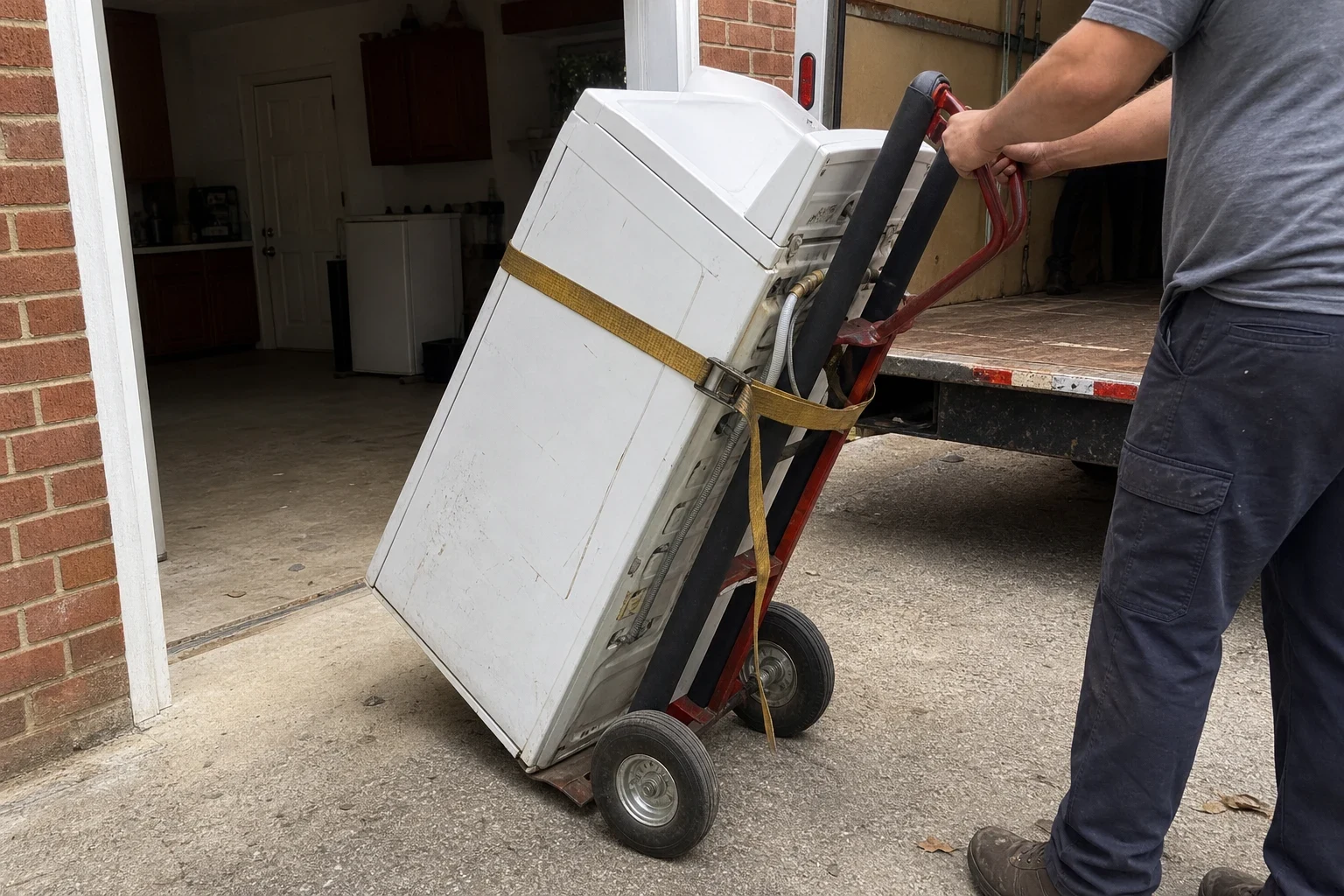
We pad door frames and lay runners over hardwood, tile and carpet. Heavy units go on an appliance dolly with straps, so a 300-pound refrigerator rolls instead of being dragged.
Refrigerant-holding units
Refrigerators, freezers, window air conditioners and dehumidifiers all contain refrigerant. We keep the lines intact during removal and take these units to a recycler that recovers the refrigerant properly.
Water heaters and laundry pairs
Tank water heaters are glass-lined steel and often full of sediment, so we make sure they are drained first. Washer and dryer pairs are some of our most common pickups, including stacked units that need to be separated.
Sweep-up afterward
Moving a fridge usually reveals dust, lint and the odd lost magnet. We sweep the spot where the appliance stood before we leave.
Signs it is time to let an appliance go
- Rust through the cabinet
- Surface rust is cosmetic, but rust eating through the floor of a washer or the base of a water heater means the steel is failing. Leaks usually follow.
- A compressor that runs constantly
- A refrigerator that hums nonstop and still struggles to stay cold often has a tired compressor or a refrigerant leak. Long Georgia summers make that worse, and the repair can cost more than the unit is worth.
- The new one is already on order
- If a replacement is coming and the delivery crew charges extra to take the old unit, or will not take it at all, we can clear it out first so the space is ready.
- A spare sitting in the garage
- The old fridge or chest freezer moved out to the garage years ago and is now mostly empty. It still draws power and still takes up floor space.
- Cracked glass or chipped enamel
- A cracked glass cooktop or chipped enamel inside an oven exposes the metal underneath. Both are signs the finish has reached the end of its life.
What the visit looks like
- 1
A look around and a written price
We check the appliance, the way out and any stairs or sharp corners. Before anything is lifted, you get an upfront price with no hidden fees.
- 2
Covering the route
We put down floor runners and pad the door frames, then make sure power and water are off and the hoses are empty.
- 3
Carrying it out
We strap the unit to a dolly, wheel it out and tie it down upright in the truck. Fridges ride standing up so the sealed lines stay protected.
- 4
Sending each unit to the right place
At our yard, every appliance goes where its materials belong: scrap metal, refrigerant recovery or, for the little that is left, disposal.
What changes the price of appliance removal
We price each appliance job from what we find at your home, so the estimate happens on site and is free. Weight, access and what is inside the unit drive most of the cost.
- How big and heavy
- One person can carry a small under-counter fridge. A side-by-side refrigerator or full-size chest freezer needs two people and extra time.
- The path to the truck
- Stairs to a basement, tight hallways and upstairs laundry rooms take more work. A unit in the garage that rolls right to the truck is the easiest job.
- Units with refrigerant
- Anything holding refrigerant needs its own trip to a recovery facility, so it costs more to remove than a plain steel washer.
- Number of appliances
- When several appliances go in one visit, they share the trip and the truck. If a garage or basement needs clearing too, ask about pairing it with a garage cleanout or basement cleanout.
Questions about appliance removal
- Do I need to disconnect the appliance before you come?
- Not for power or water: we unplug the unit and shut off and cap the water valves. Gas is different. Have a qualified tech disconnect and cap a gas range or dryer ahead of time so the line is sealed safely.
- What happens to the refrigerant in my old fridge?
- The sealed lines stay untouched, and fridges, freezers and AC units go to a recycler that removes the refrigerant before the metal is processed. It is never let out at your home.
- Do you take appliances that no longer work?
- Yes. Running or not, the steel, copper and other materials can still be recovered. Rusted or water-damaged units are fine too.
- Should I empty the fridge before you arrive?
- Please do. Food spoils quickly in a hot truck and can leak. Pull out only the loose shelves; fixed ones can stay in.
- How soon can you come out?
- We offer same-day and next-day service, depending on the week's schedule. Give us a call and we will pick a time that works for you.
Time to get rid of the old washer or fridge
Let us know what needs to go and where it is in your home. We will stop by, give you an upfront price and take it out neatly whenever you are ready.